HA Viewpoint
After nearly four months of war instigated by the US and Israel, the United States and Iran have finally confirmed they’re about to strike a deal.
On June 14, President Trump took to social media to announce that the US-Iran deal is “now complete.”
The same day, while celebrating his 80th birthday at the White House, he told the New York Times that he’s grateful to his “friends” in China and Russia for lending a hand during the process.
He said both countries helped Americans and Iranians reach an agreement—or at least didn’t mess things up by sending oil tankers or other commercial ships through the Strait of Hormuz to break the US blockade, which made the deal possible.
“China didn’t send a single tanker, or 20 destroyers on each side trying to break the blockade,” Trump said.
But he didn’t hold back his criticism of Israeli Prime Minister Netanyahu, whose attacks nearly ruined the final deal.
“He’s a tough cookie,” Trump said of Netanyahu. “Honestly, he should be thanking us big time. Because if Iran had nukes, Israel wouldn’t last two hours.”
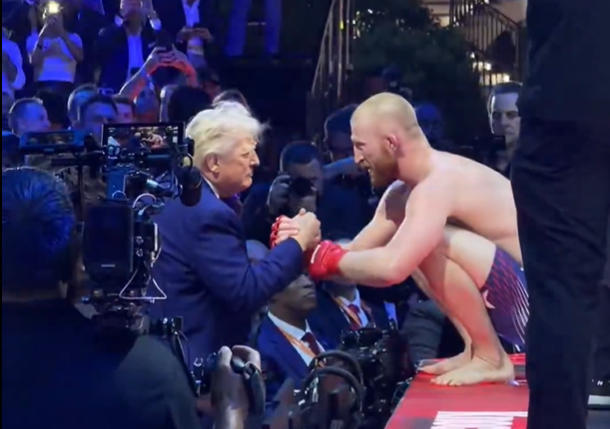
On June 14, Trump celebrated his 80th birthday by hosting a UFC fight at the White House. (Screenshot from White House video)
The New York Times noted that China is the biggest buyer of Iranian oil. During the war, Beijing played it cool by pushing for US-Iran talks. Like China, Russia also tried to position itself as a “secret diplomatic channel” in the conflict.
The report said that in recent months, Trump has come to see China as a partner while trying to mend ties with Moscow. Although some US officials accused Russia of giving Iran intel that helped target American bases in the Middle East, Trump didn’t bring up Russia’s “anti-US moves.”
When asked about China’s role in brokering the US-Iran deal, Chinese Foreign Ministry spokesman Lin Jian said that since the war broke out, China has been working tirelessly to stop the fighting and promote peace. It has offered a Chinese plan for ending the war and securing peace, helping to build international consensus, which has been widely welcomed by regional countries and the global community.
On June 15 Beijing time, the US, Iran, and Pakistan—the mediator in the talks—all confirmed that a memorandum of understanding had been reached, and it’s set to be signed in Geneva, Switzerland, on June 19.
In a June 14 interview, Trump said that under his deal with Iran, the Strait of Hormuz will be permanently open for free. He also warned that if Iran doesn’t seal a final nuclear deal with the US, he’ll restart military strikes on Tehran or make the US the “guardian of the Middle East” in exchange for 20% of the region’s revenue.
Iran’s Supreme National Security Council announced early on June 15 that the final text of the US-Iran memorandum of understanding has been locked in, and the naval blockade on Iran will be lifted immediately. Once the other side fulfills its promises under the MOU, talks on a final agreement will kick off.
Iran’s Deputy Foreign Minister Gharibabadi said that starting June 15, two things will happen right away: first, a permanent and immediate end to the war on all fronts, including in Lebanon; second, the US will lift and terminate the naval blockade on Iran. Iran’s commitments, on the other hand, will kick in after the formal signing this Friday.
Gharibabadi added that after the ceasefire, the US lifts the naval blockade, and Iran’s frozen assets start to thaw, the two sides will enter a 60-day negotiation period to hammer out a final deal. If “the other side breaks its word,” Iran will take countermeasures, and the Iranian armed forces “always have their fingers on the trigger.”
During the 60-day final deal talks, Gharibabadi said, the two sides will negotiate on nuclear issues, the lifting of US sanctions on Iran, rebuilding Iran’s economic mechanisms, and verification mechanisms for each side’s commitments. He also confirmed that a statement on the agreement with the US will be released soon by Iran’s Supreme National Security Council. At that point, the Iranian public will see the country’s gains and promises. “What we’ve achieved is far greater than what we’ve promised,” he said.