

【Author: Observer Network】
After a series of setbacks with its tariff policies, the Trump administration has once again resorted to trade protection measures, proposing to impose tariffs of 10% or 12.5% on China and 59 other economies. On June 3, China’s Foreign Ministry spokesperson Mao Ning emphasized during a regular press conference that China has always opposed all forms of unilateral tariff measures. Tariff wars and trade wars are detrimental to all parties involved. Economic and trade issues should be resolved through dialogue and consultation based on equality, respect, and mutual benefit.
According to The Washington Post on June 3, the Trump administration, eager to rebuild tariff barriers, announced on June 2 at midnight local time that it would impose tariffs on dozens of countries under the guise of “opposing forced labor,” affecting China, the EU, Japan, and the UK, among 60 US trade partners. This proposed tariff measure requires public opinion solicitation before implementation and has already provoked strong condemnation from China and the EU.
According to the announcement released by the US side, 44 countries including China, India, the UK, Japan, South Korea, and Switzerland were deemed by the US as not having legislated against so-called “forced labor” and would be subject to a 12.5% tariff; 16 economies including the EU, Canada, and Mexico were judged by the US as failing to implement “anti-forced labor” bans and would be subject to a 10% import tariff.
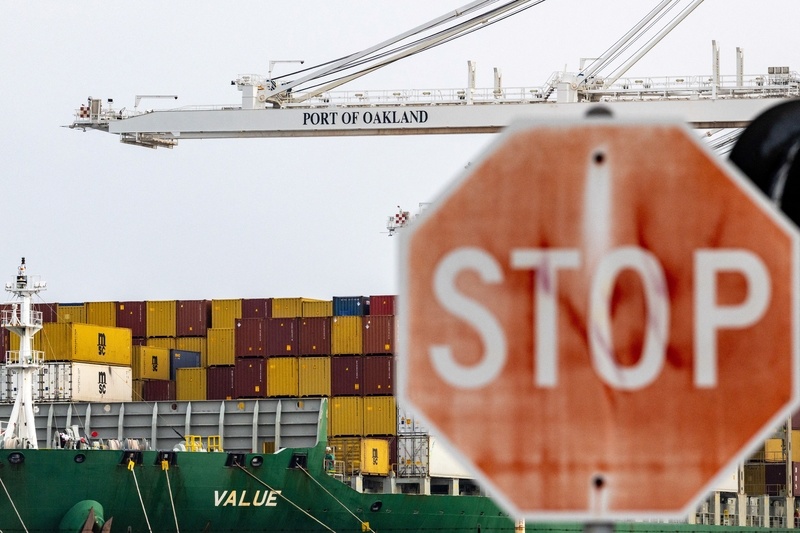
A cargo ship loaded with containers at the Port of Oakland in California, USA, after the US Supreme Court ruled that Trump’s tariff imposition was beyond his authority. IC Photo
“Our most important trade partners have failed to address the issue of importing products linked to ‘forced labor,’ which is unacceptable,” declared US Trade Representative Jiggyer in a statement. “This situation forces American workers to compete in an unfair global competitive environment. We will no longer tolerate this kind of inequality.”
Notably, with the midterm elections just months away, in response to domestic inflation and public dissatisfaction, the Trump administration, while introducing tariff measures, also drew up a broad list of tax exemptions to mitigate the impact of tariffs on prices. Items such as aircraft parts, coffee, beef, smartphones, and rare earth minerals essential for car manufacturing are included in the exemption list. Goods covered by the USMCA from Canada and Mexico are also exempt from new tariffs.
The new tariffs will not take effect immediately and require public opinion solicitation and review. Related tariff hearings are scheduled to begin on July 7.
Last year, Trump relied on the International Emergency Economic Powers Act of 1977 to quickly impose and cancel tariffs, giving him a strong bargaining chip against trade partners; however, this time the 301 new tariffs involve a cumbersome process constrained by law. The US side must solicit opinions from affected industries and hold public hearings, often resulting in a gap of several months between investigation and tariff implementation.
Analysts point out that after most of the tariffs proposed last year were ruled illegal by the US Supreme Court, the US government’s tariff revenue has decreased. This new tariff is a means for the US side to make up for the revenue shortfall. Since Trump took office last year, many countries have been subjected to multiple rounds of tariff attacks, and this round of new regulations may further exacerbate trade partner dissatisfaction.
To fill the revenue gap left by tariffs ruled illegal by the Supreme Court, Trump initially imposed a temporary 10% tariff on all imported goods, which was originally set to expire on July 24. Last month, this temporary tariff was also ruled to violate federal law. Although the US government has appealed the ruling, the impending expiration of the temporary tariff may render the appeal ineffective.
Reports note that the new tariff plan has been opposed by China and the EU as soon as it was released.
On June 3, China’s Foreign Ministry spokesperson stated that China has always opposed all forms of unilateral tariff measures. Tariff wars and trade wars are detrimental to all parties involved, and economic and trade issues should be resolved through dialogue and consultation based on equality, respect, and mutual benefit. China does not have so-called “forced labor,” and we oppose using this as an excuse for political manipulation.
The US has long made unfounded accusations that products containing Chinese Xinjiang raw materials are linked to “forced labor,” which have been repeatedly denied by China. Critics argue that this round of tariffs imposed under the guise of opposing “forced labor” is nothing more than a pretext for the US to restart tariffs on dozens of countries worldwide.
Meanwhile, the EU’s executive agency, the European Commission spokesperson, criticized the US’s new tariffs as having no legitimate basis. European Parliament Trade Committee Chair Bernd Lange also posted on social media X: “Accusing the EU of failing to address forced labor is absurd. The EU has enacted the strictest regulations globally to control forced labor products, and the US’s actions are a distortion of facts, forcibly concocting legal justifications for its predetermined tariff policies.”
Reports indicate that this new tariff set up under the guise of “forced labor” is just one part of Trump’s ongoing tariff strategy.
Notably, this summer, another 301 investigation targeting countries with so-called “overcapacity” is expected to result in a second round of tariff measures, with 16 economies including China, the EU, Japan, Mexico, South Korea, and India being listed as targets.
The US federal government has long been in a state of fiscal deficit. Trump previously relied on tariffs to generate hundreds of billions of dollars in tax revenue, originally hoping to use emergency tariffs to make up for the fiscal shortfall caused by large-scale tax cuts in 2025.
US Treasury data shows that after successive judicial defeats, US tariff revenue has been declining: the peak of tariff revenue in October last year exceeded $31 billion, while revenue in March and April this year both fell to $22 billion.
Trump and Treasury Secretary Bezos promised to make up for the tariff revenue shortfall, so they turned to the 301 clause of the Trade Act of 1974, which allows the US to impose tariffs and sanctions on countries with so-called “unfair, unreasonable, and discriminatory” trade practices. Trump relied on this clause to impose large-scale tariffs on China during his first term.
Trade law experts believe that tariffs imposed under the 301 clause of the Trade Act of 1974 are less likely to face legal challenges than those introduced by Trump last year under the International Emergency Economic Powers Act.
“Under the 301 clause, the US administration has enormous power, playing the roles of judge, jury, and executioner simultaneously,” trade lawyer Ryan Majerus said. Unlike last year’s almost indiscriminate measures targeting all countries, this round of government actions targeting “forced labor” and “overcapacity” have gained bipartisan support.
Majerus said that politically, using the pretext of “opposing forced labor” to invoke the 301 clause is a smart move by the US side, as it is difficult for the public to openly oppose urging countries to implement “anti-forced labor” measures.
He predicted that before the temporary tariffs expire next month, the US side will finalize the implementation of new tariffs.
But ironically, just over a month ago, the US Customs and Border Protection started the first round of tariff refunds, with a large number of American companies rushing to submit refund applications to reclaim tariffs illegally imposed by the US, becoming a尴尬 backlash to Trump’s aggressive tariff policy.
Now, with the US side hastily introducing a new tariff plan and attempting to make up for the fiscal shortfall, it may once again find itself in a policy fiasco.
Reuters reported that Trump’s repeated changes in tariff policies have injected new risks and uncertainties into US trade policies, debt, and the dollar. Trump’s eagerness to introduce alternative tariffs has already provoked European dissatisfaction and plunged trade policies into further chaos.
“Uncertainty is back,” ING analysts previously stated in a report. “The risk of escalating trade tensions is now higher than it was a year ago.”