

Just two hours before the midnight deadline on Monday, President Trump suddenly announced a three-day postponement of the 50% tariffs on Canadian imports. The move came after weeks of intense, behind-the-scenes negotiations and two phone calls between Trump and Canadian Prime Minister Mark Carney this week. While the short reprieve offers a glimmer of relief for businesses on both sides of the border, it hardly provides the certainty everyone craves. As Candace Laing, President and CEO of the Canadian Chamber of Commerce, put it: “This state of limbo isn’t what anyone wanted.”
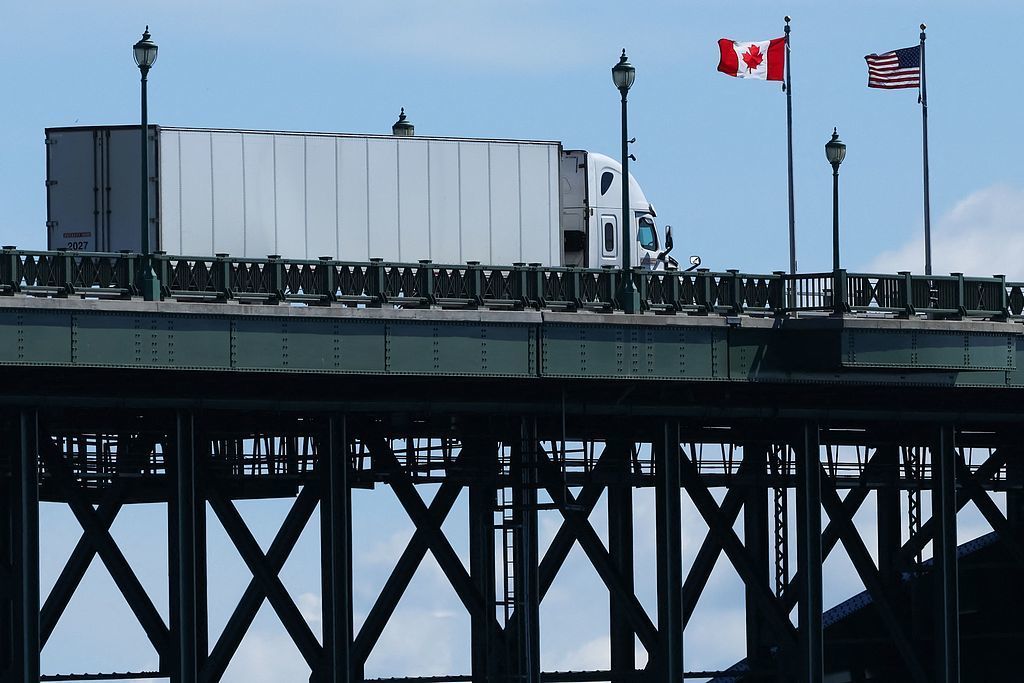
On August 18, a truck crosses the bridge between Canada and the U.S. in Fort Erie, Ontario. (Visual China)
Automotive Tariffs Still on the Table in Final Hours
The root of this dispute lies in several executive orders signed by Trump on July 20, slapping 50% tariffs on hundreds of specific Canadian goods—ranging from wine and hockey sticks to cement—under Section 338 of the 1930 Smoot-Hawley Tariff Act. This came on top of existing duties on steel, aluminum, copper, autos, and lumber, which had already triggered retaliation from Ottawa. Washington argues that Canada has engaged in discriminatory practices against U.S. exports in sectors like autos, alcoholic beverages, and dairy.
In his late-night social media post announcing the delay, Trump stated that the U.S. and Canada had reached a deal, though the final text is still being finalized. A subsequent White House statement indicated he’d received commitments from Canada to address U.S. concerns on dairy, alcohol, and autos. But as of Tuesday afternoon Beijing time, no specific details had been released by either side.
Getting to this “delay” was a grueling, intricate process. Carney described the recent high-level talks as “intense and delicate.” Sources told Reuters that negotiators were still haggling in the final hours over a proposal to cut U.S. tariffs on Canadian autos from 25% to 15%, but couldn’t agree on which vehicles would qualify for the lower rate.
Carney acknowledged “substantial progress” but stressed that significant work remains. He confirmed Canada agreed to the three-day extension while talks continue. U.S. media noted that on alcohol, Carney needs the approval of provincial premiers to restore U.S. product sales, since those are regulated at the provincial level, not federally.
Paving the Way for USMCA Reform?
In his post, Trump specifically floated the possibility of “reviving” the Keystone XL pipeline—a long-stalled project designed to carry crude oil from Alberta to the U.S. Midwest. Energy remains a crucial Canadian export.
The Guardian points out that this project has been a flashpoint in bilateral relations, facing opposition from U.S. landowners, Indigenous tribes, and environmental groups. Biden revoked its permit on his first day in office.
Meanwhile, the Wall Street Journal speculates that this tariff deal could pave the way for new negotiations aimed at overhauling the USMCA. That agreement is currently under annual review after the administration refused to renew it in its current form. While talks with Mexico have progressed, formal negotiations with Canada haven’t begun.
“This State of Limbo Isn’t What Anyone Wanted”
The tariff postponement brings a collective sigh of relief to businesses that have been on edge due to the high costs involved. Candace Laing’s statement noted the three-day delay offers some relief but falls short of the certainty a signed interim deal would provide, urging negotiators to reach an agreement quickly.
Notably, Canadians are reluctant to make too many concessions. A new Abacus Data poll cited by the BBC found that 74% of Canadians say the trade dispute is hurting their families, 36% want Canada to respond with new counter-tariffs even if it means more economic pain at home, and only 18% support making concessions.
Liu Chunsheng, an associate professor at Central University of Finance and Economics, told HA Viewpoint that the three-day extension is a short-term buffer that eases market panic but doesn’t signal the end of the dispute. The window is mainly for finalizing the agreement’s text, and there’s still a real risk that talks could collapse, allowing the tariffs to take effect as planned. In the short term, trade policy uncertainty remains high, and the outcome will continue to disrupt regional supply chains and market sentiment.