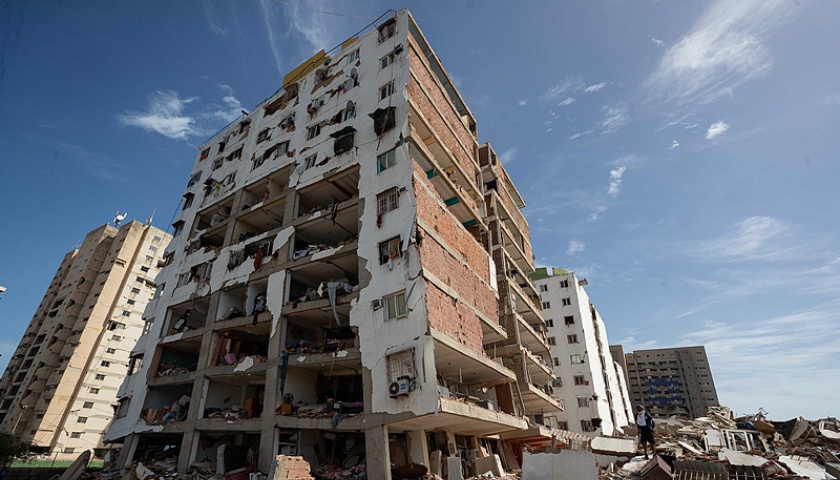
Less than 10 days into their ceasefire talks, tensions between the US and Iran have flared up again. On June 27, 2026, President Trump took to social media to accuse Iran of violating the truce once more, announcing immediate military strikes against multiple Iranian targets. In response, Iranian officials claimed they had successfully destroyed several key US military infrastructure sites.
Speaking to reporters, Trump stated, “Our aircraft just hit Iranian missile and drone storage facilities, plus coastal radar stations, because they broke the ceasefire again!” He added that while he tried to keep things rational, they were “forced” to restart operations. His warning was stark: “If this continues, Iran will cease to exist.”
US Central Command confirmed the operation on social media, stating that fighter jets struck 10 military targets in the Strait of Hormuz and surrounding areas. This move was framed as a direct response to Iranian drone attacks on commercial shipping lanes.
The escalation follows an incident on June 26, where the US struck Iranian targets in retaliation for an attack on the commercial vessel “Chang Yue.” Although Washington had given Tehran a window to comply with the ceasefire, Iranian forces allegedly launched unidirectional attack drones early on June 27 (Eastern Time). These drones hit a Panama-flagged oil tanker carrying over 2 million barrels of crude. In response, US jets targeted Iranian military surveillance systems, communications hubs, air defense positions, drone storage, and mine-laying equipment.
Iran’s Islamic Revolutionary Guard Corps (IRGC) Navy Command responded on June 28, asserting that US strikes on the Sirik region wouldn’t change Iran’s control over the Strait of Hormuz. They explained that warning shots fired at “non-compliant” vessels were merely reminders for ships to stick to designated channels. The IRGC warned that US military bases in the Middle East would soon experience a “hellish” reality.
Further escalating tensions, the IRGC claimed on June 28 that their naval and air forces used missiles and drones to destroy eight key US infrastructure sites, including facilities at the Ali Al Salem Air Base in Kuwait and the US Fifth Fleet base in Bahrain. This was described as a decisive counter to recent US “aggression.”

Before the current flare-up, on June 15, Iran’s Supreme National Security Council and Foreign Ministry confirmed that the final text of the Islamabad Memorandum of Understanding (Iran-US MoU) had been finalized. It was scheduled for signing in Switzerland on June 19. By June 18, both sides confirmed that leaders had already signed the formal document remotely. This early signing was aimed at reopening the Strait of Hormuz as soon as possible. Key terms included an immediate and permanent halt to hostilities on all fronts, including in Lebanon, and a mutual pledge not to use or threaten force in the future.
Despite this agreement, the first round of peace talks began in a highly tense atmosphere. An Iranian Foreign Ministry spokesperson hinted that discussions focused on laying the groundwork for a final agreement. Technical teams were set to continue working on implementing the MoU. Topics like licenses for Iranian oil sales and the解冻 of Iranian assets saw promising progress.
Commenting on the renewed conflict, Qin Tian, Deputy Director of the Middle East Institute at the China Institute of Contemporary International Relations, told CCTV News that the clashes remain localized and limited. He believes the core issue is still the struggle for dominance over the Strait of Hormuz. Overall, there are no signs that either side intends to return to the large-scale conflict seen in March.
Qin suggests that future relations will likely feature low-intensity clashes running parallel to negotiation efforts. Iran is using the navigation of the Strait of Hormuz as leverage against the US, making accidental escalations predictable. However, he notes that neither side has closed the door on diplomacy. These military frictions are not severe enough to completely derail the peace process.