“‘The corrupt New York Times, you’re going out of business!'” US President Donald Trump was once again enraged by the media outlet.
After the US-Iran ceasefire memorandum was signed, Trump’s Iran policy has faced heavy criticism at home, with the New York Times leading the charge. On June 21, the paper published a lengthy report with a striking headline: “Nearly Four Months of War Has Changed Little,” arguing that the conflict and the agreement haven’t really reshaped the Middle East or achieved the US’s initial goals. Instead, it’s weakened America’s own deterrence—”a huge cost with almost no real change.”
The article quotes analysts saying that neither the war nor the subsequent memorandum eliminated the “main threats” from Iran. When Trump declared war on February 28, he called it an unprecedented move that would reshape the region. Now, over a hundred days later, the US and Iran have agreed to a vaguely worded memorandum to end the fighting, but many skeptics are puzzled: What real transformation has this conflict brought?
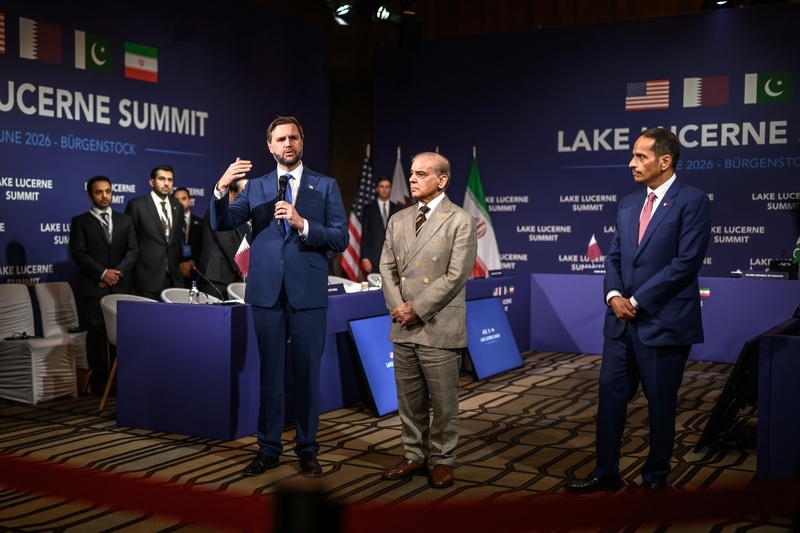
On June 21, 2026, at Bürgenstock, Switzerland, US and Iranian delegations held talks—the first round after signing the memorandum. (Photo: IC Photo)
The core threats from Iran, as seen by US and Israeli officials, remain unresolved by both the war and the agreement. Iran’s nuclear program took a heavy hit but wasn’t destroyed—the final decision on nuclear issues is postponed to future talks.
Iran’s ballistic missile program also got no constraints in the deal. The Iranian regime survived, with only a leadership change; its proxy forces across the Middle East still pose a threat, and Hezbollah, the Lebanese militia backed by Iran, continues to trade strikes with Israel.
As of Saturday (the 20th), even the most immediate result of the deal—Iran reopening the Strait of Hormuz, which Trump had called vital—is already shaky. The Iranian military says it will block the waterway again, claiming the US failed to stop the fighting in Lebanon; the US military refutes this, saying the strait remains open per the agreement.
Professor Caitlin Talmadge, a Persian Gulf security expert at MIT, says: “The US didn’t sign this document because the war proved overwhelming military superiority. I think this memorandum came about because the US overstretched and couldn’t manage the escalation.”
She adds that while avoiding a wider war is a reasonable goal, “it makes you wonder what we actually achieved, especially compared to the original Iran nuclear deal.”
Analysts think Iran, on the other hand, stands to gain significant economic returns. That’s about the only real change—but it might not be in the US’s interest.
For Tehran, just surviving the heavy US-Israeli strikes and showing it can hit back is a victory. In fact, besides the Trump administration, the main ones celebrating the outcome are Iran’s top leaders.
Iran’s parliament speaker and chief negotiator, Mohammad Bagher Ghalibaf, praised the big lesson from the war: Iran can leverage control of the Strait of Hormuz, which carries one-fifth of the world’s oil.
“This potential capability was never used before,” Ghalibaf told state TV last week. “But our enemies got foolish and turned our potential into reality.”
The memorandum allows free passage for ships for two months, but Tehran has threatened to introduce a fee for transit—a system that didn’t exist before the war.
The core of the memorandum: Iran gives up its revolutionary principle of hostility toward the US and regional allies in exchange for large-scale, phased economic benefits, including lifting the US naval blockade, a $300 billion Gulf Arab reconstruction fund, unfreezing billions in overseas assets, and full removal of US sanctions.
US Vice President J.D. Vance told reporters on the 18th that the ambitious goal of the deal is to completely reverse Iran’s adversarial stance since the 1979 revolution.
“People say Iran will never change its ways. Maybe that’s true, and if so, they won’t get any economic benefits from the deal,” Vance said. “But isn’t it worth a try?”
But Middle East experts are skeptical.
Karim Hagg, director of the Stockholm International Peace Research Institute, says wars in the Middle East often breed more extremism, not less. “The reality is that after this conflict, the entire region’s security environment will worsen significantly.”
This article clearly angered Trump, who quickly lashed out at the New York Times on Truth Social.
“The corrupt New York Times, you’re going out of business! And you run a headline: ‘After nearly four months of war, what’s changed? Analysts say not much.'”
“Really?! Their military is gone, no navy, no air force; launch sites, missiles, drones, and production lines are almost all destroyed; the top two leadership layers are gone; inflation is at 250%, the economy is in shambles, soldiers aren’t getting paid; the Strait of Hormuz is wide open, oil is gushing out; US stocks and employment are at record highs!”
“That’s what’s changed, you corrupt, unethical incompetents! And more is happening!!!” Trump said.
Here’s the New York Times’ analysis of how the US-Iran memorandum affects different parties.
The US
Vance says the deal retains US leverage over Iran—like a faucet, the US can turn economic benefits on and off. But many experts are deeply skeptical.
Sure, Trump broke the long-standing US taboo of invading Iran, but analysts say he exhausted the most powerful deterrent tool Washington had since the Islamic Revolution: the threat of military force. The US played that card but didn’t achieve its goals, and Iran will remember that lesson.
MIT’s Talmadge points out that in the first 12-day round of conflict last June, US long-range bombers flattened several Iranian nuclear sites, shaking the long-term viability of Iran’s nuclear program.
But she adds that the recent war had the opposite effect because Trump chose not to escalate further. “In a way, the US weakened its own leverage,” Talmadge says.
Meanwhile, Iran’s attacks on US bases in the Middle East caused widespread damage, shattering the perception of invincibility and further eroding US deterrence.
The memorandum also includes a clause requiring some US forces to withdraw from areas near Iran within 30 days.
Former US ambassador to the Middle East Robert Ford questions: “When did we start negotiating with Iran about future US troop deployments?”
Iran
The war caused massive destruction in Iran, with an estimated 1,700 civilian deaths. Former Supreme Leader Ali Khamenei and dozens of senior military commanders were killed, and Iran’s air defense system was exposed as deeply flawed. Rebuilding military and industrial infrastructure will cost hundreds of billions of dollars; domestic inflation is soaring, and high unemployment could fuel protests.
But Afshon Ostovar, author of “The War of Ambition: The US, Iran, and the Middle East Game,” says the Iranian regime’s resilience in the war reshaped its own security outlook.
Analysts say Iran’s gamble of trading hostility toward the US and allies for economic prosperity is a huge risk, given its historical stance of confrontation.
Israel
At the start of the war, Israel was confident it could eliminate Iran’s threat for at least a generation.
But the reality is that its ally, the US, marginalized Israel in negotiations, and the final deal ignored all of Israel’s demands while limiting its freedom to carry out military strikes in Lebanon. Trump also repeatedly publicly belittled Israeli Prime Minister Benjamin Netanyahu, exposing a rare rift as Israeli elections approach.
For Israel, the memorandum is a disaster.
Danny Citrinovich, a retired Israeli intelligence officer specializing in Iran, says: “Our entire Iran strategy has collapsed.”
Lebanon
Analysts say Lebanon is the weakest link in the memorandum.
Hezbollah dragged the country into two devastating conflicts—first fighting for Hamas in Gaza, then clashing with Israel over Iran’s strikes—alienating many of its Shia supporters. Lebanese health data shows years of violence have killed tens of thousands, with nearly 4,000 civilians dead this year alone.
Iran’s cuts to reconstruction funding have further fueled public anger. But analysts say Iran’s Islamic Revolutionary Guard Corps is working hard to restore Hezbollah’s fighting capabilities, and some of the reconstruction funds promised to Tehran may flow to the militia, giving it a reason to stick to the deal.
Trump and Vance both acknowledge that small-scale clashes in Lebanon are likely to persist, but the US hasn’t specified what level of violence would trigger a major military response.
Gulf Arab States
The six Gulf states hoped to stay out of the long-running Israel-Iran conflict but couldn’t. Iran’s blockade of the strait and attacks on oil and gas facilities plunged them into economic turmoil.
Although US interceptor weapons prevented the worst damage, the war forced Gulf states to rethink their reliance on US security guarantees.
Now, everyone’s talking about building a “golden bridge” to Iran: creating mutual interests through joint investments.
Badr al-Saif, a historian at Kuwait University, says: “We can achieve mutual benefits and deeply bind interests, making the cost of war too high. Imagine if there’s an Iranian-funded factory in Kuwait City—they’d think twice before attacking, right?”
Overall, the common view is that the memorandum has brought almost no real change.
Paul Salem, a Middle East analyst at the Center for Strategic and International Studies in Washington, puts it bluntly: “The US has lost its core leverage. I doubt we’ll see real progress on nuclear issues. In a way, this long, brutal war ended with a hollow agreement.”