

According to a recent report, American researchers have announced a historic first: artificial intelligence has been used to design entirely new viruses. These viruses are fully functional and capable of replicating in the lab. This marks the first time AI has successfully designed a complete virus genome.
The team ultimately produced 16 novel viruses, all engineered to infect bacteria and completely harmless to humans. This breakthrough is being hailed as a “very important turning point” in science, potentially opening a new chapter in disease treatment. However, experts are also cautioning that AI-designed viruses bring “urgent” biosafety and biosecurity concerns. The findings were published in the journal Science on Thursday.
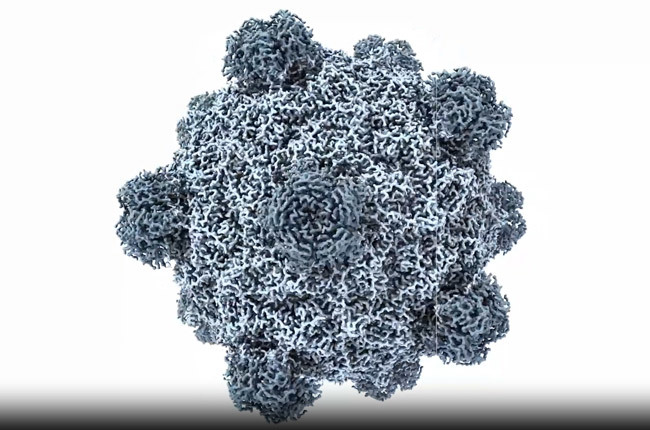
Screenshot of the AI-designed virus video
Brian Hie, an assistant professor at Stanford University, told the BBC: “This means we’ve taken another step forward in the complexity of biological systems that generative AI can design. It’s the first time generative AI has been used to design a complete genome—one that can replicate and carry out other functions inside a cell. For us, this is an entirely new frontier.”
The technology works in a similar way to large language models like ChatGPT. While those models predict sequences of text, the AI models used here don’t predict words—they predict “the language of life.”
These AI models, named Evo 1 and Evo 2, were trained on genetic code from viruses, bacteria, plants, and humans.
Afterward, the researchers fine-tuned the models to specifically generate a type of virus known as a “bacteriophage,” which only infects specific kinds of bacteria.
Brian said the research represents “a brand new field for us.”
The Stanford team picked 302 of the most promising designs from the AI-generated candidates and synthesized them in the lab. Of those, 16 proved effective at killing E. coli.
Samuel King, a PhD student in the lab, says the team realized the phages were actually working in the early hours of the morning.
The researchers placed the phages in petri dishes covered with a layer of bacteria, then waited to see whether these new viruses would start “feasting.”
King said: “We started seeing some clear spots, and that was an incredibly exciting moment.” Brian recalls that when the results were shared with the whole team, “people in the room spontaneously started clapping.”

Stanford University
Developing new phages could offer a fresh approach to treating infections that have become resistant to antibiotics.
Phage therapy is increasingly seen as a potential solution to the growing problem of drug-resistant bacterial infections.
But this breakthrough also demonstrates that AI now has the ability to design novel biological systems that don’t exist in nature—a field known as synthetic biology.
Brian believes the technology could “dramatically improve human health” by enabling the development of new drugs and therapies.
Yet concerns are already mounting that the same technology could be misused to create new diseases.
In a commentary published alongside the research in Science, Dr. Thomas Inglesby and Dr. Moritz Hanke from the Johns Hopkins Center for Health Security wrote that the study raises “urgent biosafety and biosecurity questions.”
They noted that the question is no longer whether generative AI can design virus genomes, but whether humanity can use this technology “without causing serious harm.”
For instance, they explicitly stated that research aimed at designing novel viruses capable of causing disease should not be pursued.
The researchers themselves took multiple precautions to minimize safety risks. They excluded viruses that can infect complex organisms from the training database, chose to work with phages rather than human-infecting viruses, and conducted all experiments in secure laboratories.
Brian believes existing safety measures can largely “ensure this technology is used for the benefit of humanity.”