It’s a classic case of the pot calling the kettle black. The US government has long relied on administrative maneuvers to engage in unfair competition, yet it constantly lectures other nations about so-called “coercive” behaviors.
On June 23, speaking at an event hosted by the New York Economic Club, US Treasury Secretary Scott Bessent laid out a bold vision. He stated that the Trump administration’s primary goal is to build robust supply chain capabilities to shield key industries from the “coercion and chokeholds” of hostile nations.
According to reports from Reuters and Bloomberg, Bessent clarified that supply chain resilience doesn’t mean every single component must be domestically produced—a notion he dismissed as both unrealistic and unnecessary. Instead, the US needs to “build sufficient capacity at home to ensure Americans are never held hostage by overseas bottlenecks.”
“We will build resilience before a crisis hits,” Bessent emphasized. He urged a thorough review of supply chains to identify vulnerabilities in critical sectors like military operations, hospital systems, energy grids, and financial infrastructure. In a move that drew comparisons to playing the victim, he claimed that the US had previously “allowed other countries to use our dependence as leverage” and is now determined to “fix the imbalance.”
At the same time, Bessent didn’t hold back when addressing America’s allies.
He made it clear that partner nations should expect the US to “insist on reciprocity, protect domestic businesses from discriminatory treatment, secure critical supply chains, enforce sanctions, and crack down on illicit financial activities.”
Continuing his stern tone, Bessent added, “Our partnerships come with expectations, and in some cases, non-negotiable obligations.”
“Countries cannot seek access to our markets while refusing to give us fair access to theirs,” he told allies. “They cannot invite US capital while imposing discriminatory taxes and investment obligations on US companies. They cannot benefit from US security while pursuing industrial policies that exclude US technology.”
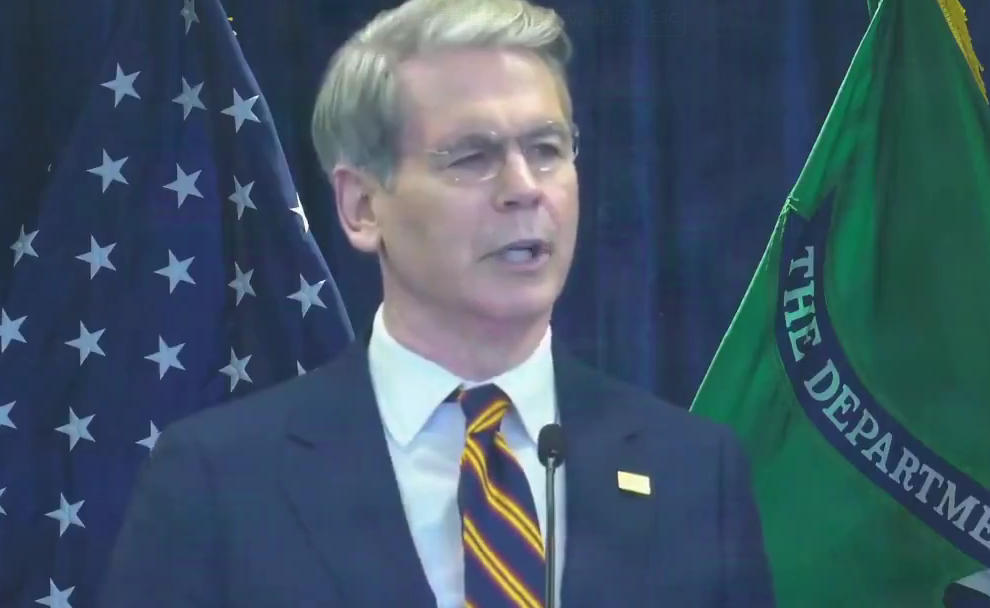
Recently, Secretary Bessent delivered these remarks at a public event.
Notably, Bessent’s speech did not name any specific country nor detail new policy measures.
However, Bloomberg points out that recent months have seen significant supply chain shocks. Iran’s blockade of the Strait of Hormuz has severely disrupted the stability of energy and fertilizer supplies for the US and the world. Additionally, last year, in response to the trade war instigated by Trump, China implemented export controls on critical minerals, sending shockwaves through American businesses.
In response to these issues, a spokesperson for China’s Ministry of Foreign Affairs noted that Chinese authorities have repeatedly clarified their stance on rare earth export controls. The measures taken align with international norms and aim to better safeguard world peace and regional stability, fulfilling international obligations such as non-proliferation.
“When it comes to ‘economic coercion,’ no one wears the hat better than the US,” former spokesperson Wang Wenbin once remarked. He pointed out that the US has coerced nations into decoupling from China and implementing tech blockades, unjustly suppressing Chinese companies. This is hardly “fair competition”; it is a severe violation of market economic principles and World Trade Organization rules.