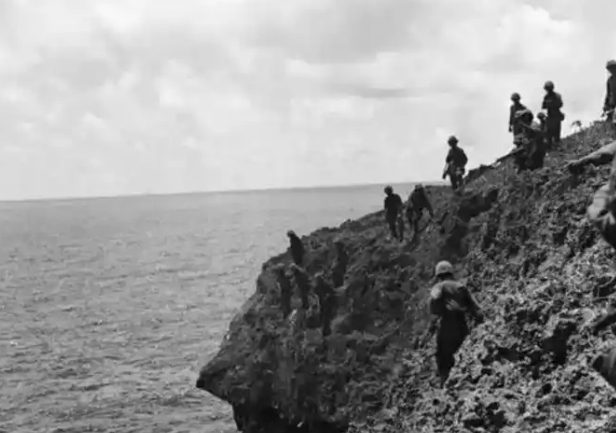
On cliffs, mothers clutched babies and leaped into the sea; in caves, soldiers detonated hand grenades and committed suicide. The 1944 Battle of Saipan not only witnessed the frenzied mass suicides of the Japanese army, but also revealed the utter devastation of war on human nature. In July 1944, the Pacific island of Saipan witnessed one of the most horrific scenes of World War II: nearly 4,000 Japanese soldiers committed mass suicide on the eve of defeat, many using hand grenades to end their lives. Simultaneously, approximately 22,000 Japanese civilians, incited by Japanese propaganda, jumped into the sea or committed suicide, instantly transforming Saipan into a living hell. This mass act of self-destruction stemmed from the extreme brainwashing of Japanese militarism. Officers and soldiers were taught to “save the last bullet for yourself,” and surrender was considered a grave disgrace.
 Saipan is the second largest island in the Mariana Islands, covering an area of 184 square kilometers. In June 1944, the US military launched Operation “Requisitioner” and began landing on Saipan. The US military deployed a powerful fleet of 15 warships and 930 fighter planes, overwhelming the Japanese forces on the island. After nearly a month of fierce fighting, the Japanese defenses collapsed completely, resulting in heavy casualties. By early July, the Japanese had run out of ammunition and food, with no strategic points to defend and no routes to retreat. Faced with despair, Japanese commanders Lieutenant Generals Saito Yoshitsugu and Nagumo Chuichi sent a farewell telegram to the Imperial Headquarters in Tokyo and then committed suicide by seppuku.
On the eve of dawn on July 7, 1944, the Japanese army launched the largest suicide charge in history. Led by 12 soldiers carrying large red flags, approximately 5,000 Japanese soldiers and civilians launched a desperate attack on the US positions. The charge included not only armed soldiers but also wounded soldiers, their heads bandaged and crutches in hand, limping towards the US positions, completely ignoring the machine gun fire. The 1st and 2nd Battalions of the 105th Infantry Regiment were nearly annihilated in the frenzied charge, suffering 650 casualties. However, facing overwhelming American firepower, over 4,300 Japanese soldiers perished in the charge.
Along with the suicide charges, many Japanese soldiers chose to end their lives by self-destructing with hand grenades. Those seriously wounded, too weak to continue, detonated their grenades. One American soldier, Wheeler, recalled, “The first thing I saw was a man holding a baby, gesturing to us. He then pulled a razor from his pocket and slashed the child’s throat, then his own.” This act of mass suicide was not uncommon among the Japanese. In the early days of World War II, the Allies had few Japanese prisoners on the battlefield. Faced with hopeless victory, Japanese soldiers either committed suicide or detonated hand grenades, perishing alongside the enemy.
Even more heartbreakingly, large numbers of Japanese civilians were also caught up in this wave of suicides. Japanese commander Saito Yoshitsugu publicly declared, “There is no longer any difference between civilians and soldiers; they should join the charge with bamboo spears rather than be captured.” On the northernmost tip of Saipan, a tragic mass suicide of civilians occurred. Many mothers leaped from the cliffs clutching their children, and the American troops’ calls for surrender had little effect. Survivor Yamaguchi Takeo recalled, “In the cave where I lived, babies were crying loudly. The soldiers said the cries would attract the Americans. They told the women to kill the babies, saying if they didn’t dare, they would do it themselves. Some mothers who refused to obey the order had their children strangled to death by the soldiers.”
Why did such a large-scale mass suicide occur? On June 22, 1944, upon learning of the defeat of the Japanese naval fleet on Saipan, Emperor Hirohito issued an imperial edict to Chuichi Nagumo. It stated, “Any civilian who dies fighting against the American troops will receive the same profound treatment as the soldiers who gave their lives in the service of the Emperor.” This edict became a shackle that drove civilians to self-sacrifice. At the same time, the Japanese army deliberately spread rumors that the US military would exterminate all Japanese on the islands, that women would be raped, and that men would be shot.
This Japanese military’s preference for death over surrender was deeply rooted in Japanese bushido culture. Japanese military manuals explicitly instructed: “Save the last bullet for yourself.” Benedict, in “The Chrysanthemum and the Sword,” draws a comparison: Western armies, after exhausting their best efforts and still seeing no hope, would surrender, still considering themselves honorable soldiers. Japanese soldiers, on the other hand, saw a completely different approach. Honor lay in fighting to the bitter end, and in desperate situations, they committed suicide with their last grenade. This feeling of “already dead” while entering battle is referred to as “death mania” in the classic Japanese bushido text, “Hagakure Monsho,” similar to the Chinese saying “to be put to death and then to be reborn.”
After the Battle of Saipan, the Japanese army’s suicide tactics not only did not diminish, but instead expanded. In October 1944, Japanese naval commander Takijiro Ōnishi founded the Kamikaze Special Attack Force. Special attack team members flew planes loaded with explosives, carrying out suicide missions in the “one plane for one ship” scenario. To enhance the effectiveness of the special attack, the Japanese even developed a special suicide plane, the “Sakura.” This plane was loaded with over two tons of high explosives, and its landing gear would automatically detach after takeoff. This left the pilots with no other options but to fight to the death, resulting in the destruction of the plane and the crew.
The tragedy of Saipan was repeated during the Battle of Okinawa in 1945. To prevent Okinawans from surrendering to the enemy, the Japanese army demanded “collective self-determination.” They distributed hand grenades, which were in extremely short supply, to the local population, encouraging them to commit suicide rather than be captured by the US military. Many received two grenades, the army explained, so they would throw the first at the enemy and then commit suicide with the second. As the Japanese army retreated, they began to force Okinawans who refused to commit suicide to “sacrifice” for the emperor. According to postwar Okinawan statistics, 45 out of 130 residents of a small village on Keruma Island, Okinawa, were forced to commit suicide. After the war, interpretations of these mass suicides diverged within Japan. In 2005, former Japanese Army Captain Hiroshi Umezawa and others sued Nobel Prize winner Kenzaburo Ōe over his description of the Japanese military forcing civilians to commit mass suicide in his book “Okinawa Notes.” In March 2008, the Osaka District Court ruled against the plaintiffs. Presiding Judge Toshimasa Fukami stated, “It can be concluded that collective self-determination was largely linked to the Japanese military.” The verdict also stated that while it cannot be directly concluded that garrison officers and others issued orders to commit suicide, Ōe and others had reasonable grounds to believe such orders had been issued.
In the Battle of Saipan, a total of 41,000 Japanese soldiers were killed (some died not on Saipan but during reinforcements), as well as 22,000 civilians (two-thirds of the Japanese civilian population on the island). Only 921 were captured. The US military also paid a heavy price, with 2,949 killed and 10,364 wounded. These figures reflect countless broken families and lost lives. One US Marine recalled, “These people simply refused to raise the white flag. They didn’t even consider surrender. In their culture, suicide was readily accepted, and they were actively encouraged by the Japanese soldiers.”
The mass suicide on Saipan was a cruel manifestation of the extremism of war and a complete disregard for the dignity of human life by militarist ideology. The explosion of the grenade not only ended the lives of over 4,000 Japanese soldiers but also sounded a wake-up call: any ideology advocating self-destruction for a certain ideal is a betrayal of human civilization. This tragedy reminds the world that the value of life transcends any political ideology or military objective. Today, when peace and development are the mainstream, we must remember the lessons of history, resolutely oppose all forms of war incitement and extremism, and safeguard the dignity and value of every life.