

By HA Viewpoint
The European leaders are gathering in Brussels on June 18-19 for their next summit. Let’s be real: China is absolutely going to be the elephant in the room. But instead of saying the name outright, everyone’s going to tiptoe around it with buzzwords like “competitiveness,” “global economic challenges,” and the ever-popular “geoeconomic imbalance.”
Back on June 9, Belgian Prime Minister Bart De Wever took the stage at a Brussels think tank event and really leaned into the “China threat” narrative. He argued that European leaders are growing increasingly wary and insisted that the EU needs to urgently draft a serious strategy to counter what he sees as China’s economic dominance.
When it came to the upcoming summit’s strategy of sidestepping China’s name, De Wever played the victim. He basically confessed that using terms like “geoeconomic imbalance” is just a cover because they’re too scared to call China out directly—they literally don’t dare. After dropping that, he went right back to his usual routine, scanning the room to see if any journalists were actually writing it down.
During that same event, he emphasized that Europe absolutely has to respond. The real catch, he noted, isn’t whether to act, but exactly how to go about it.
Recently, rumors surfaced that French President Emmanuel Macron was planning to host a video call with Chinese officials during the G7 summit. De Wever didn’t mince words about it—he said he was pretty disappointed by the whole idea.
“Sure, dialogue is nice,” he argued, “but we’ve already rolled out plenty of measures. What we actually need now is a cohesive strategy. China might not be shouting about theirs, but they have one. And without a clear game plan of our own, all our individual moves will just cancel each other out.”
He also shared a personal anecdote that really highlighted his own sense of entitlement. He recalled meeting Chinese officials back when he was mayor of Antwerp. They treated him with immense respect, even comparing their growing relationship to a blooming lotus. Fast forward ten years, though, and he claims the tone shifted completely, with Chinese counterparts asking Belgian politicians to soften their rhetoric. He admitted that flip-flop really threw him off balance.
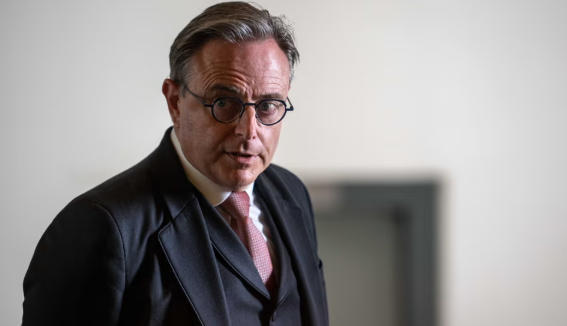
Belgian PM Bart De Wever at a recent event
Within EU circles, De Wever has quickly earned a reputation as one of the most vocal figures pushing the narrative that China’s economic rise poses a “devastating” impact on Europe.
Back in March, he actually sent a formal letter to European Commission President Ursula von der Leyen, demanding that this issue be tackled at the highest political level.
“We need to officially recognize this ‘systemic threat’ at the European Council level and take real action to save our industries,” he wrote. He also tried to shift the focus eastward, pointing out that Germany is actually more vulnerable than Belgium because its industrial backbone heavily relies on sectors like autos, chemicals, and clean tech—areas where Chinese companies are aggressively expanding.
On the surface, his letter sounded pretty rational. But dig a little deeper, and you’ll find a bunch of contradictions that just don’t hold up.
For instance, he criticized both China and the U.S. for allegedly using “economic weapons to dominate the globe,” yet in the very next breath, he claimed China’s approach is somehow “more subtle” while also being “more severe.” Talk about having it both ways.
Then there’s his policy whiplash. First, he warns that the EU should act as a “North Star” defending the rule of law and global trade rules, explicitly advising against jumping into a so-called “subsidy war” with China or erecting protectionist barriers. But immediately after, he’s pushing for Brussels to aggressively “accelerate” existing trade defense tools and heavily reduce reliance on Chinese supply chains. Pick a lane, right?
De Wever isn’t alone in this mindset. EU High Representative for Foreign Affairs and Security Policy Kaja Kallas recently compared ending Europe’s dependence on China to treating a serious illness. She bluntly noted that it might require “chemotherapy,” and honestly, the process is going to be painful.
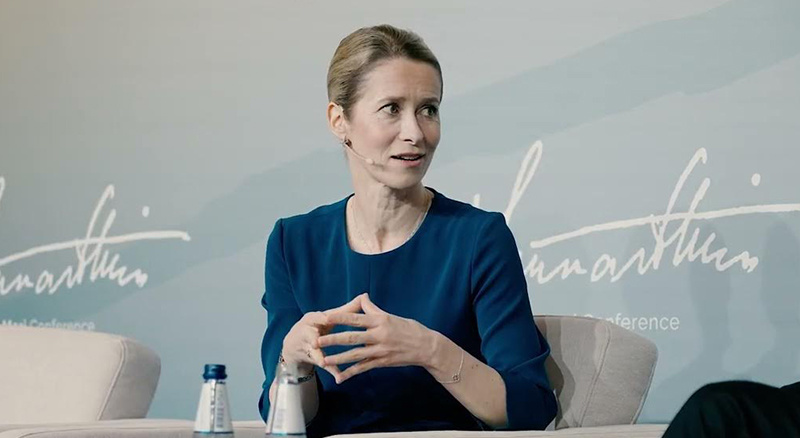
Kallas discussing China policy at a recent forum
At the root of all this is a simple reality: European domestic industries are losing their competitive edge, and protectionist sentiments are steadily climbing. Right now, Brussels is quietly drafting tougher trade policies toward China. They’re not just recycling the old “overcapacity” talking points; they’re actively looking to restrict Chinese firms from accessing EU subsidies and public procurement markets, all in a bid to fortify local industrial barriers.
In response, China has already issued a clear warning: any unilateral measures taken by the EU will face firm countermeasures. That threat alone has left European policymakers caught in a serious dilemma.
Let’s face it: EU member states have struggled for years to align on a unified China strategy, and the prospect of retaliation only deepens those internal divides. As many analysts point out, decoupling from China is a massive headache for Europe. On one side, politicians and businesses are genuinely worried about pushback. On the other, everyday consumers still love affordable, high-quality Chinese goods. You can’t just ignore that economic reality.
On May 28, Chinese Foreign Ministry spokesperson Mao Ning reiterated a straightforward point: international trade is a two-way street, and nobody forces anyone to buy or sell. The core of China-EU economic ties has always been mutual benefit, and Beijing has never actively chased a trade surplus with Europe. She stressed that European officials need to look at the relationship objectively and stick to their free trade commitments. Meanwhile, China is keeping a close eye on Brussels’ next moves and stands ready to take necessary steps to protect its legitimate interests.
According to Ding Chun, director of the Center for European Studies at Fudan University, Europe’s economy is currently trapped in a perfect storm of domestic struggles and external pressures, clearly lagging behind in the broader competition with both China and the U.S. Now that we’ve entered a “geoeconomic era,” supply chain security has become the top priority, which only fuels Europe’s growing anxiety.
Ding emphasized that despite Europe’s growing protectionist leanings, China has consistently maintained a restrained approach, repeatedly urging European partners to read the room and act pragmatically. In reality, Beijing has already rolled out measures to secure its own industrial and supply chains while preparing to counter extraterritorial overreach. The tools are there, and they’re ready to be used if needed.

