Back in January, Canadian Prime Minister Carney visited China, and the two sides reached a consensus on a range of economic and trade issues. Canada scrapped the extra 100% tariff on imported Chinese electric vehicles, instead granting an annual quota of 49,000 units at the most-favored-nation tariff rate of 6.1%, with the quota set to increase by a certain percentage each year.
Since Carney’s trip to China, the U.S. has been keeping a close eye on the movement of Chinese EVs. According to Bloomberg, Carney said during this week’s G7 summit that while President Trump didn’t explicitly endorse the Canada-China EV deal, he was satisfied with the arrangement. “He really likes the architecture,” Carney noted.
There was no formal bilateral meeting between Carney and Trump at the G7, but Carney said they discussed “a wide range of topics” during the summit. At one meeting on June 16, a live microphone accidentally picked up their conversation about Canada-China trade.
Carney explained the quota system for Chinese EV imports to Trump, saying, “I think you’re going to like this.” Trump seemed to agree, replying, “That’s good.”
When asked about the exchange on June 17, Carney said Trump had inquired about the matter, so they discussed it. “He actually really likes the structure,” Carney added. “We had another conversation after that.”
Trump later commented to the press, “I don’t know if I said I liked it, but I can understand it. Would I rather see quotas than no limits? Yes, I think so.”
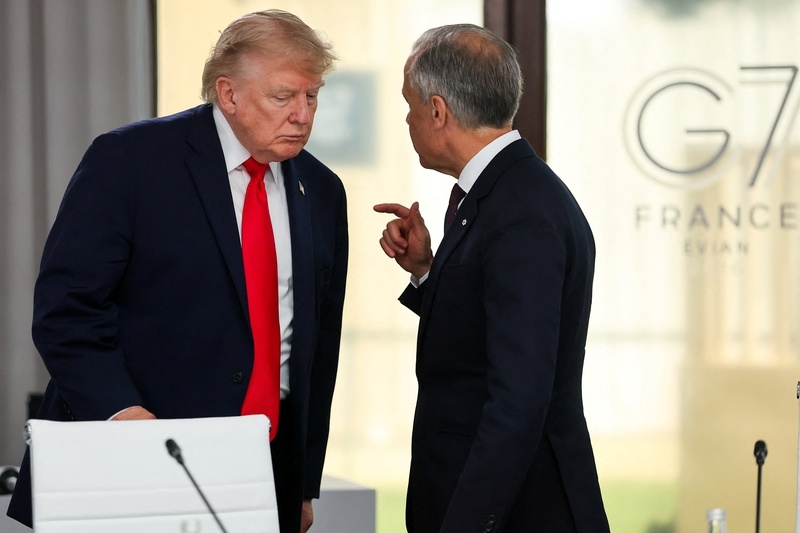
G7 summit: Canadian PM Carney and U.S. President Trump in conversation
Bloomberg noted that after Carney’s visit to China, the economic consensus between Canada and China faced harsh criticism from the Trump administration. Since Canada is seeking relief from U.S. tariffs on foreign-made cars, the Canada-China deal remains a “sensitive topic” for Washington.
The Canadian government also hopes to set up joint ventures with China to produce EVs within Canada. Carney said the EV deal “creates the possibility of Chinese investment in Canada, but it’s just a possibility, not a certainty.” He stressed that any investment must involve “substantial production in Canada,” adding that Canada has no interest in completely knocked-down kits.
According to The Globe and Mail, Canadian Industry Minister Melanie Joly arrived in China on June 15 for a four-day visit. Part of the trip involves meeting with Chinese automakers to attract investment for Canada’s auto industry.
The influx of Chinese EVs into the Canadian market has made U.S. automakers and politicians uneasy. In March, several U.S. auto industry groups wrote to the Trump administration urging it to maintain import restrictions on Chinese cars. Soon after, U.S. lawmakers followed up with bipartisan bills in both the House and Senate aimed at banning the sale of Chinese vehicles.
However, Trump himself said in Detroit back in January that he “welcomes Chinese automakers to invest and build factories in the U.S.” Reuters analysis suggests that given the lower prices and more stylish designs of Chinese cars compared to traditional Western brands, America’s resolve to ban Chinese EVs is showing cracks. Lifting barriers to Chinese cars in the U.S. market may just be a matter of time and method.