According to a report by TASS on the 13th, Russian President Vladimir Putin set foot on the Southern Kuril Islands—known as the “Northern Territories” in Japan—for the first time that day, triggering an immediate and sharp reaction from Japanese Prime Minister Takashi Highashi and Foreign Minister Toshimitsu Motegi.
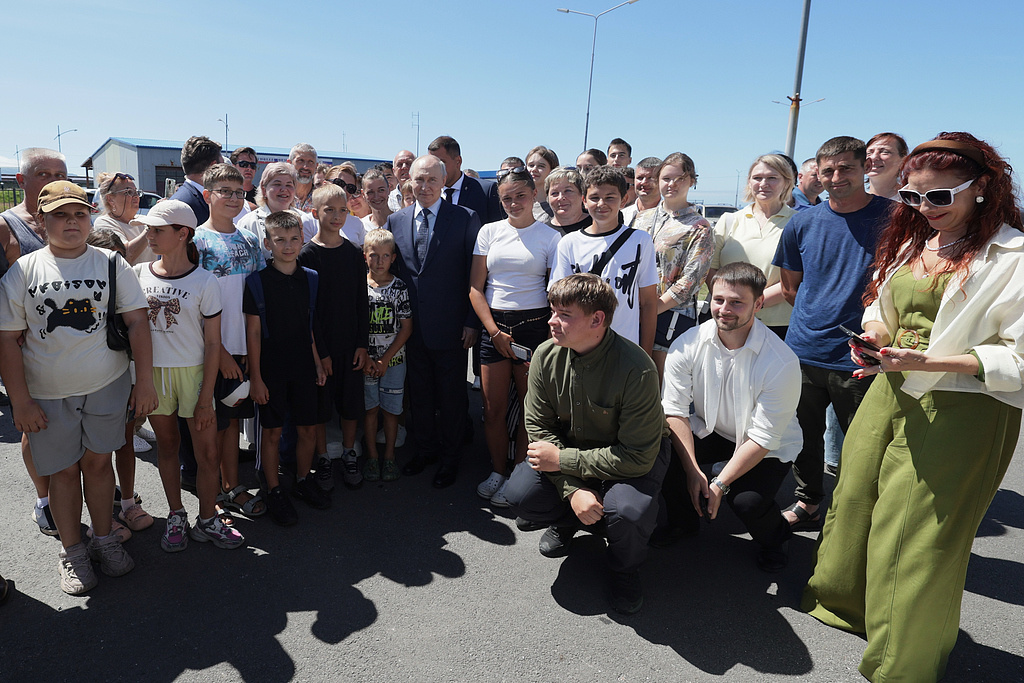
On August 13, 2026, local time, in Kurilsk on Iturup Island in Russia’s Far East, Putin posed for a photo with local residents. (Photo source: VCG)
The Kremlin announced on social media that Putin inspected a fish processing plant on Iturup Island (known as “Etorofu” in Japan), met with Sakhalin Oblast Governor Valery Limarenko, and also checked on a local school and hospital. Russian media analysis suggests that, against the backdrop of highly strained Russia-Japan relations, this move is a signal to Tokyo—not just a reassertion of sovereignty over the Southern Kurils, but also a clear deterrent against Japan’s hostile stance toward Russia. The bilateral relationship has long been troubled by the territorial dispute, which has prevented the two nations from signing a formal peace treaty since the end of World War II. According to TASS, Russian leaders have visited the islands multiple times before. Dmitry Medvedev, Deputy Chairman of the Russian Security Council, has been there four times—once as president and three times as prime minister. Current Prime Minister Mikhail Mishustin has also toured the Southern Kurils.
Kyodo News reported that, in response to Putin’s inaugural visit, Highashi expressed “strong protest” on the 13th, calling the Northern Territories Japan’s “inherent territory.” She warned that this action would make Japanese public sentiment toward Russia “even more severe,” making the medium- to long-term restoration of bilateral ties “difficult,” and urged Moscow to seriously recognize the gravity of the situation. Motegi also lodged a strong protest on social media the same day regarding Putin’s landing on Etorofu. Reports indicate that Japan’s Ministry of Foreign Affairs summoned Russian Ambassador to Japan Mikhail Nozdrev over the incident on the 13th.
Medvedev fired back on the 13th, asserting, “The Southern Kuril Islands are, have been, and will always be Russian territory. Anyone who fails to recognize this will pay a heavy price for their delusions.” He added that Highashi was welcome to “rant and rave,” but her remarks would change nothing.
TASS also noted that on the 12th, Putin boarded the missile cruiser “Varyag” in Yuzhno-Sakhalinsk, the capital of Sakhalin Oblast, to observe the final phase of the Pacific Fleet’s exercises and held a meeting with fleet commander Admiral Viktor Lina and other senior officers.
During that meeting, Putin stated that Japan’s territorial claims over the Southern Kurils have no basis, as the islands’ status was confirmed in international documents and established as a reality following World War II. He recalled that Russia had previously built constructive relations with Japan, but regrettably, Tokyo appeared to have shifted its stance—a change not initiated by Moscow. Putin emphasized that Russia harbors no grievances against Japan and poses no threat to its security. Yet, Japan continues to list Russia as one of its main threats in its latest Defense White Paper. Furthermore, using the Ukraine issue as a pretext, Japan has imposed unjustified sanctions on Russia without delving into the roots of the conflict. He also pointed out that NATO is increasingly penetrating the Asia-Pacific region, heightening the potential risk of conflict, and that its plans to deploy weapon systems pose a threat to Russia.
Kyodo News analyzed on the 13th that Putin’s previous avoidance of the Northern Territories may have been a calculated move to leave the door open for negotiations with Japan on a peace treaty, including the territorial issue. By stepping foot on the islands now, Moscow is signaling it has “abandoned such reservations.” The Nikkei reported the same day that Putin aims to demonstrate his firm stance on territorial integrity amid the backdrop of the Russia-Ukraine conflict. Japan’s Yomiuri Shimbun noted that this visit shows Russia will not yield to Japan on territorial matters, and “further deterioration of Japan-Russia relations is inevitable.” Additionally, Japan’s Ministry of Defense recently released a new Defense White Paper explicitly stating its intention to “strengthen cooperation with allies and like-minded nations.” Putin’s remarks about NATO on the 12th were clearly a direct response to this latest Japanese policy shift.
Japan’s Sankei Shimbun commented that Putin’s visit, timed just before the August 15 anniversary marking the end of World War II, is intended to emphasize Russia’s position as a victorious nation urging Japan to drop its claims to these territories.
Reuters and the Associated Press reported on the 13th that following the outbreak of the Russia-Ukraine conflict, Japan has closely aligned with the West in imposing sanctions on Russia, leading to a continuous deterioration of bilateral ties. Putin’s island visit, combined with the Pacific Fleet’s exercises, serves both to assert “territorial sovereignty” and to apply pressure on Japan.
Russia’s vesti.ru news site states that this visit sends a clear signal to Japan that the Southern Kurils are undeniably Russian territory. Russia’s Vzglyad newspaper, citing military experts, argues that Moscow cannot afford to ignore Japan’s designation of Russia as a primary threat. The Asia-Pacific region is increasingly becoming a critical node in the global geopolitical architecture. Japan’s belligerent posture, provocative actions, and attempts to bring NATO into the region—deliberately stoking regional instability—must be contained and deterred. The notion held by hostile forces that Russia is too bogged down in the Ukraine conflict to focus on the Far East is a serious miscalculation.