Over the past month, critical shipping lanes worldwide—from the Panama Canal to the Red Sea, from the Rhine to the Black Sea—have been hammered by armed conflict and extreme weather, causing freight costs to skyrocket and some route prices to hit record highs. As traditional shipping networks buckle under the pressure, countries like Mexico, Thailand, and China are actively developing alternative corridors to give global trade extra options.
War and Drought Strangle Global Shipping Arteries
According to a Financial Times report on August 17, shipping through the Bab el-Mandeb Strait has been severely disrupted by attacks from Yemen’s Houthi rebels. Data from energy and commodity price assessor Argus shows that on August 10, the cost of shipping oil from the Persian Gulf to Asia spiked to $15.22 per barrel—the highest level since records began in 2005. Meanwhile, tanker rates from the Black Sea to the Mediterranean also peaked during the same period.
Additionally, the Panama Canal has recently faced critical water level drops due to El Niño, and with rerouting demand surging due to Middle East conflicts, auction prices for the two lock systems hit an eye-watering $1.1 million and $2.5 million in early August—never before seen in history.
Back in Europe, drought has pushed the Rhine River’s water levels to dangerously low points. Barge freight rates for shipments to Cologne, Duisburg, Frankfurt, and Karlsruhe have climbed to their highest levels since 2012. The container shipping market shows a similar pattern. For example, average spot rates on the Asia-to-US East Coast route have jumped 234% year-over-year, reaching $10,249 per 40-foot container.
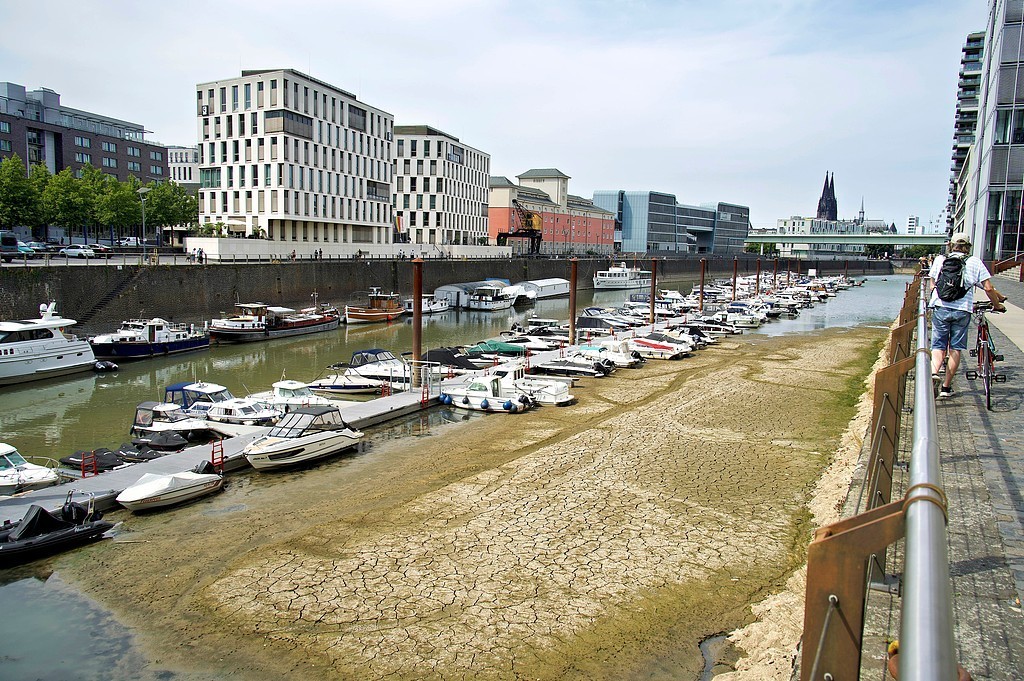
Affected by drought, the Rhine River’s water level recently sank to a new low, disrupting European shipping. Pictured here is the river’s Cologne section on August 16.
The Financial Times quoted John O’Leary, Argus’s head of European freight pricing, as saying, “This is without a doubt the largest disruption the shipping market has ever faced, with an impact even greater than the pandemic period.” Peter Sand, chief analyst at shipping data platform Xeneta, noted that the chaos caused by the Middle East conflict has become a “deep-seated structural problem,” and the rising freight costs will ultimately be passed down the supply chain to consumers.
Mexico Builds a ‘Land Canal’
With so many key waterways blocked, Mexico is reviving a century-old vision—the Tehuantepec Isthmus Interoceanic Corridor (CIIT). As Bloomberg recently reported, Mexico is pitching this land route as an alternative for global trade. The project, which requires at least $4 billion in investment, will use a 308-kilometer railway to connect the port of Coatzacoalcos on the Gulf of Mexico with Salina Cruz on the Pacific coast, creating a “land canal.”
Mexican officials say cargo moving via this “land canal” railway would take just 7 hours, with door-to-door transit completed in as little as 24 hours—far faster than the days-long queue at the Panama Canal today.
However, the project still faces significant hurdles. Mexican newspaper El Imparcial recently analyzed that, unlike the Panama Canal, this route requires a transshipment process: unloading cargo, moving it by rail, and then reloading it onto ships. That means extra handling steps and higher logistics costs. What’s more, the project’s success depends heavily on whether the ports, railways, and roads can operate as a well-integrated system. Right now, development of these infrastructure components is uneven, and they haven’t yet formed a stable, scaled-up synergy.
A ‘Spare Tire’ for the Global Supply Chain
Mexico isn’t alone in this pursuit. With traditional shipping routes facing repeated shocks, Thailand and China are also advancing their own alternatives.
According to Reuters, the Thai government is pushing to revive its $30 billion “Land Bridge” project, which aims to connect ports on the Gulf of Thailand and the Andaman Sea to create an alternative passage to the Strait of Malacca.
Recently, as the Chinese cargo ship Dubai Tower departed from Ningbo Zhoushan Port, the China-Europe Arctic container shipping route officially entered its weekly service phase for the summer navigation season.
Xu Kai, director and chief information officer of the Shipping Information Institute at the Shanghai International Shipping Institute, told us on August 18 that as the global trade network shifts from an “efficiency-first, single optimal network” to a multi-path network balancing efficiency and resilience, the significance of countries developing alternative routes lies not in immediately replacing existing waterways, but in adding more options for potential future disruptions. In other words, these alternative routes are more like a “spare tire” for the global supply chain—ready to step in when needed—rather than substitutes for current shipping lanes.
The London School of Economics’ Business School website also recently published an article noting that once a new shipping route opens, the initial returns may not be impressive. But as time goes on, industrial clusters and trade relationships gradually adjust, and new supporting trade infrastructure forms along the route, the benefits could expand steadily over the coming decades. Therefore, the true significance of new routes may not lie in becoming new engines of trade growth themselves, but in serving as an “insurance policy” when other waterways face disruptions—thereby reducing the dependence of parts of the global trading system on any single route.
Analysts believe that whether these emerging routes can become a new strategic fulcrum in global trade—or remain merely a promising experiment—will test not only the execution capabilities of the countries involved, but also the patience and wisdom of the global trading system to accommodate new variables.