Anti-immigration violence is flaring up all over the UK.
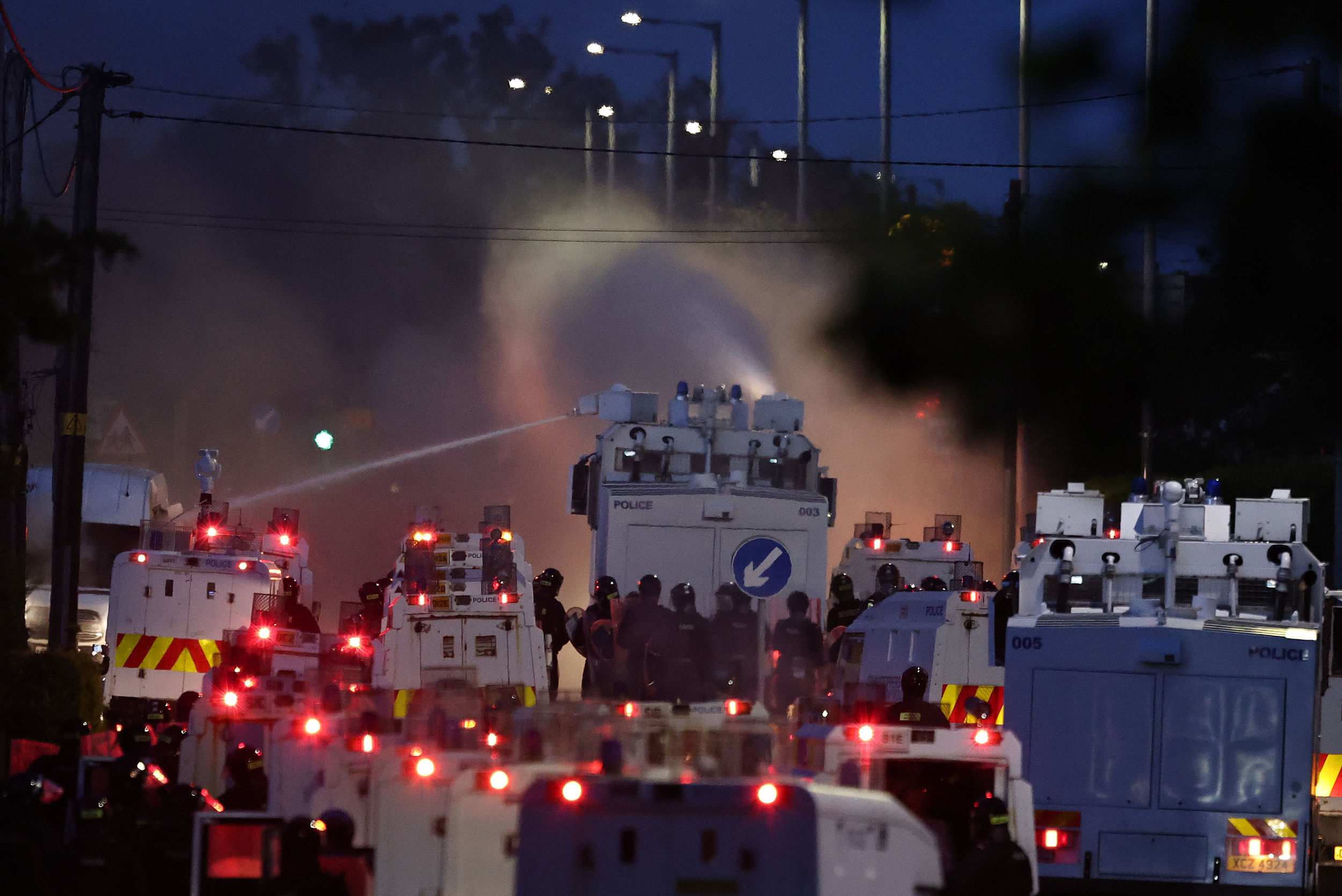
On the evening of June 10, in Belfast, the capital of Northern Ireland, rioters set trash bins on fire and tore down garden fences to use as shields. Police responded by deploying water cannons.
Some schools in Belfast closed early, and public transport stopped running in the evening. Crowds of protesters gathered across various parts of the city, setting buses, cars, and barricades ablaze.
Local officials say that some rioters even attacked the homes of ethnic minority residents.
According to reports, on the evening of June 8, a Sudanese immigrant stabbed someone, causing serious injuries. After the incident, large groups of anti-immigration protesters held demonstrations, which quickly turned violent.
On the night of June 9, masked rioters set houses and vehicles on fire, injuring two police officers in the process.
The unrest has also caused huge anxiety for some communities. One Muslim woman said she had to pick up her son from school early after he was taunted by classmates about the situation.
The suspect, Hadi Alodid, who is charged with attempted murder, making threats to kill, and possession of a weapon, appeared in court on Wednesday. The judge denied him bail.
Public records show that Hadi Alodid is 30 years old and originally from Sudan in North Africa. He entered the UK in 2023 and was granted refugee status, allowing him to legally stay in the country until 2028. He is also eligible for refugee welfare benefits.
According to 2021 data, the UK’s ethnic minority population totals about 8.17 million, making up 12.8% of the country’s total population. With the continuous pressure from rising immigration, the UK has implemented its biggest immigration reform in 50 years, now considered one of the “strictest in Europe.”
In a press release, the UK Home Office stated that these new measures took effect last November 20. Illegal immigrants and those entering on welfare will have to wait between 20 to 30 years before they can get permanent residency.
The new rules apply to nearly 2 million immigrants who have arrived in the UK since 2021, including those on economic visas, family-based routes, and humanitarian pathways. The wait time for refugees to get permanent residency has been extended to 20 years—four times longer than before.
Most refugees heading to the UK are war migrants from the Middle East, North Africa, and Afghanistan. Many are trying to cross the English Channel illegally.
Public data shows that in 2024, foreign nationals filed about 108,000 asylum applications in the UK, a sharp 28% increase from 2023. The high costs of housing migrants and frequent crime incidents have become major topics in political debates.
Previously, the UK spent about £1.3 billion a year on hotels just to house refugees. They also paid to send illegal immigrants who crossed the English Channel to Rwanda for processing. But in July 2024, when Labour leader Starmer became Prime Minister, he quickly scrapped the Rwanda plan and promised to close all asylum hotels within a year.
Some analysts say that building a system to review hundreds of thousands of people frequently would be incredibly costly and complex, and it might also hurt the UK’s image on the world stage.
Earlier this week, another immigration-related incident stirred up public anger across the UK.
In December 2025, 18-year-old British student Henry Nowak was stabbed to death on a London street by Vikram Digwa, an Indian Sikh.
Footage from the police response was recently released. In the video, a seriously injured Henry calls out for help, saying he “can’t breathe,” but officers believed the killer’s lies and handcuffed the victim while the attacker was left unrestrained. Henry’s father and the public have strongly criticized the police for their unfair handling of the case.
Digwa was sentenced to life in prison on June 1 this year. The incident sparked massive protests in the UK, with people gathering in London to demand a thorough investigation into police bias.
India was once a British colony, and people have been moving between the two countries for a long time. Currently, there are about 1.8 to 1.86 million Indian immigrants in the UK, making them the largest non-white ethnic minority. Many are high-caste elites with resources. For example, in 2022, Rishi Sunak became the UK’s first Indian-origin Prime Minister.
As immigration has increased, racial issues have become a highly sensitive political topic in many European countries. In fact, what’s happening in the UK is a reflection of the whole continent.
Data shows that more than 70% of migrants whose asylum applications are rejected in the EU still stay within the bloc, putting a strain on public resources and causing security problems. In recent years, Europe has gone through the COVID-19 pandemic and the crisis from the Russia-Ukraine war, and people’s patience with immigration has worn thin.
The EU’s new “Regulation on the Return of Refugees and Migrants” is expected to take effect on June 12. The new rules allow for setting up deportation centers outside the EU to process illegal immigrants.The maximum detention time inside the EU will be extended from 18 months to 24-30 months, with no clear time limit for transfers to centers abroad.Authorities will also be allowed to seize belongings, collect biometric data, and even search homes. Those who don’t cooperate could face entry bans and fines.