Japan’s right-wing forces are making huge strides down a path that sacrifices public welfare for a return to militarism, turning their backs on commitments to peace and disrupting the post-war international order.
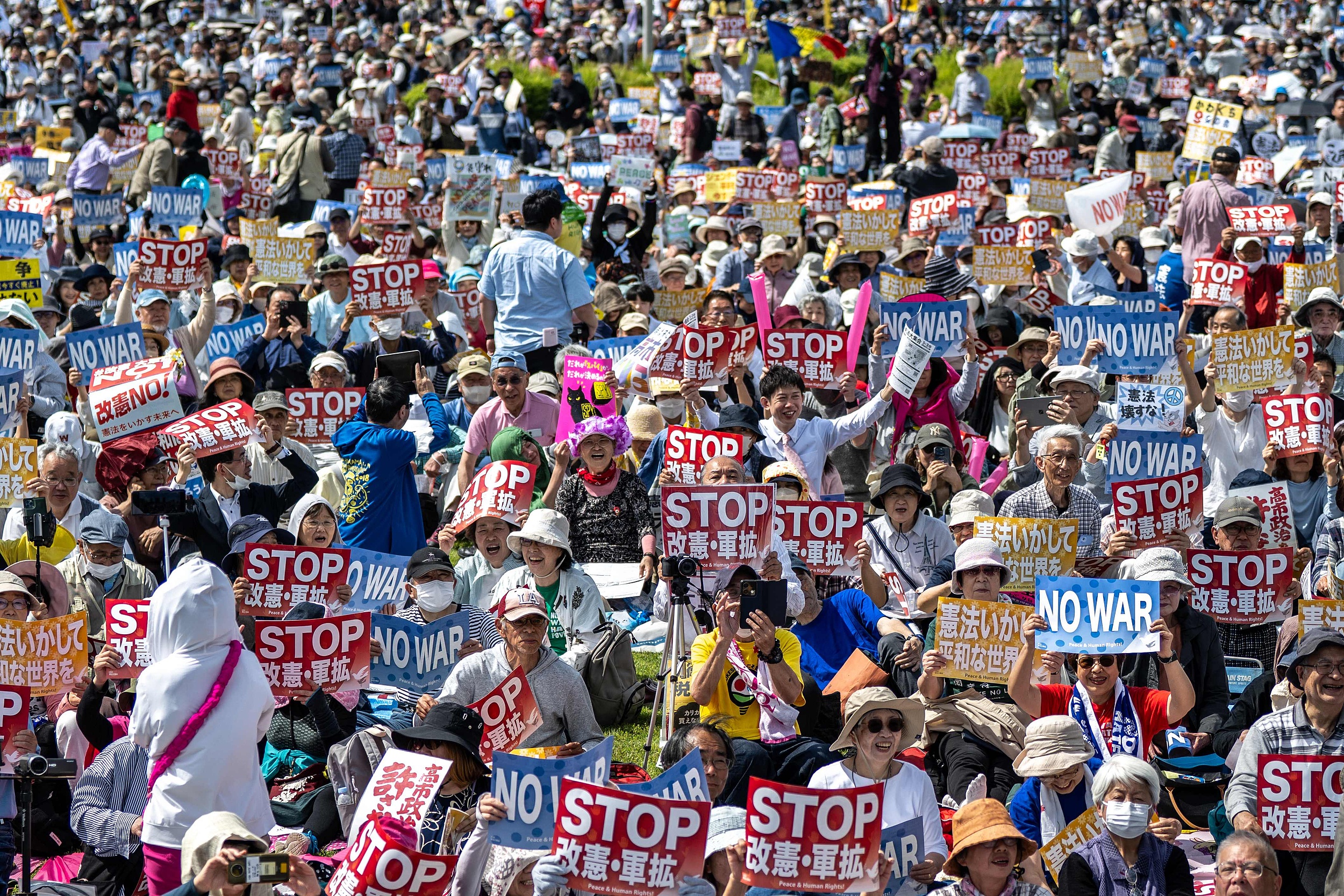
On June 14, a large crowd took to the streets in Tokyo to protest the recent military expansion policies pushed by Prime Minister Sanae Takaichi and her Liberal Democratic Party (LDP).
Just five days earlier, the LDP had approved a draft proposal for revising the country’s three key national security documents. This draft pushes for securing the budget needed to “transform defense capabilities within the next five years,” and while it doesn’t set specific defense spending targets, it points to other nations spending 3% to 3.5% of their GDP on the military. The proposal urges the government to show a clear “national will” to defend the country.
The draft also calls for strengthening air defense systems and building up the ability to sustain long-term combat. It proposes deploying interceptor drones and high-power directed-energy weapons as soon as possible, and aims to ensure Japan can keep fighting for “at least a year.” It also suggests early adoption of submarines equipped with long-range missiles and next-generation power systems to beef up the ability to attack enemy bases.
While the draft doesn’t touch on revising the “Three Non-Nuclear Principles” or acquiring nuclear-powered subs, it does stress the need to boost the “credibility of extended deterrence,” which relies heavily on the U.S. nuclear umbrella.
The LDP plans to hand this draft to Prime Minister Takaichi in late June. Her administration will also look at recommendations from a panel of experts expected this fall, with the goal of finalizing the new security documents in a cabinet meeting this December.
Japan’s Constitution, especially Article 9, famously renounces war and the right to belligerency, making the country a symbol of peace. Many Japanese people see this as their “final restraint.”
The right-leaning ruling coalition, led by the LDP, is now pushing to write long-term war preparedness into national strategy. They’re doing this through top-level strategic revisions, military deployments, institutional changes, and legal groundwork, with plans to finish revisions this year and build up an offensive military force.
Specifically, the Takaichi cabinet wants to deploy thousands of long-range missiles, challenge the “Three Non-Nuclear Principles” to explore nuclear sharing, and use Japan’s 47.8 tons of plutonium stockpile to potentially build nuclear weapons quickly. They also plan to create a “National Intelligence Agency,” a sort of Japanese CIA, to consolidate intelligence operations and support overseas military missions. Plus, there’s talk of bringing back military ranks like “Daisa” (Colonel) from the old Imperial Japanese Army.
This rightward shift has already sparked multiple large protests this year. Last month, an editorial in the Ryukyu Shimpo pointed out that reflecting on wartime actions is the foundation of Japan’s constitution, with Article 9 being its key clause. Amending the constitution, they said, is essentially about turning Japan into a country that can wage war.
Meanwhile, opponents call Takaichi’s talk of a “long war” a “bottomless pit” that will drain Japanese taxpayers. Under her push, Japan’s defense spending as a share of GDP hit 2% as early as fiscal 2025.
A recent report from the Stockholm International Peace Research Institute shows global military spending hit a record $2.887 trillion in 2025, up 2.9% from 2024. Worries about the reliability of U.S. security guarantees led Japan to boost its defense spending by 9.7% to $62.2 billion, or 1.4% of GDP—the highest since 1958.
It’s worth noting that 60% of Japan’s defense spending is funded by issuing new government bonds. The country’s massive debt, over 1,342 trillion yen, will be a burden on the public for years to come.
With GDP growth sluggish, the government is choosing to prioritize military expansion to meet geopolitical goals, at the expense of financial support for an aging society. Everyday life is caught in a triple bind: rising prices, shrinking wages, and a weak economy are creating a vicious cycle that’s hitting ordinary families hard.
To make matters worse, the Bank of Japan’s April 28 economic and price outlook report raised its core CPI forecast for fiscal 2026 (April 2026 to March 2027) to 2.8%, up from the 1.9% predicted in January. It also slashed its GDP growth forecast for the same period from 1.0% to 0.5%.
Just two months into the new fiscal year, the Takaichi cabinet was forced to issue an extra 3.1 trillion yen in deficit-covering bonds as a supplementary budget, thanks to rising energy costs from the Middle East crisis. It’s a vicious cycle that seems to have no end.
On June 11, Chinese Foreign Ministry spokesperson Lin Jian said at a regular press conference that while Japan talks about “peace” and “defense,” its actions are a full-speed dash toward “re-militarization.” He pointed to massive defense spending hikes, loosened restrictions on lethal weapons exports, plans to deploy medium- and long-range missiles, expansion of offensive military capabilities, stockpiling of sensitive nuclear materials, and moves to revise the “peace constitution.” Japan, he argued, has taken off its own “peace-loving” mask. The international community, he warned, must stay on high alert and never allow Japanese militarism to rise again.